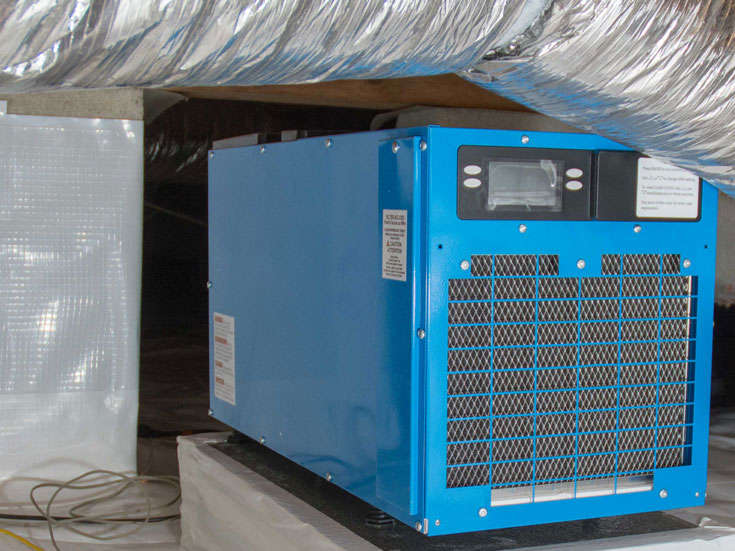
As long as your DC home has crawl space, you will have to control the moisture levels down there. Normal humidity should be between 45% and 50%. Anything higher than that and your crawl space will become damp, moldy, and smelly during hot and humid summer months. Wood beams are going to rot and your asthma and allergies get worse. A dehumidifier can be the game-changer, as it will help bring down moisture to acceptable levels and forestall many problems.
Between a standard dehumidifier or an energy efficient dehumidifier, which option is the best and what’s the difference? Read on to find out more.
When shopping for a dehumidifier, you’ll have to decide whether you’ll go for an ordinary unit or the energy-efficient model. Let’s look at what differentiates the two.
The first is energy consumption. Energy-efficient dehumidifiers beat non-qualified units with regard to usage. You’ll find yourself spending 10-20% less energy than your neighbors just to keep your home dry and comfortable.
Just like automobiles, where more HP means more noise, normal dehumidifiers are somewhat louder than energy-efficient units as they require more power to run. If you want less noise or better noise control, go for the quieter and safe energy-efficient models.
Hygiene is another differentiator between these two. An energy-efficient unit will make your home less humid and more comfortable than a normal dehumidifier. Your skin will feel less clammy and you won’t have to visit the carpet cleaners every other week, meaning less cleaning costs.
Some homeowners are concerned with the effect of greenhouse gases on the environment. To support conservation efforts, you will want to go with an energy-efficient dehumidifier which reduces environmental damage.
While you have the option of buying any dehumidifier, we strongly recommend an Energy Star certified unit for the following reasons:
Just like any home appliance, dehumidifiers have various features. Energy efficiency is, of course, a necessary feature. Equally important are features that make it easy to control humidity and maintain your dehumidifier.
You may also want to consider the air discharge location and whether the dehumidifier can connect to a home hub to control your device. Be sure to also check the operating temperature range. A unit that fits your basement’s temperature range means your machine will run smoothly and more efficiently.
If you need help installing a dehumidifier in your DC crawl space, request a free crawl space inspection. We customize solutions for your home’s needs. Our crawl space dehumidifier installation offers long-lasting results, durability, and energy efficiency. Contact us today to learn more!
Get Your Free Inspection!While there isn’t a specific location necessary for the dehumidifier, it’s typically installed near the sump pump to help with drainage.
Often the dehumidifier is installed in an area where it is visible from the opening of the crawl space. Making it easy to ensure it is functioning efficiently.
Costs vary based on your crawl space size and condition. JES Foundation Repair offers free inspections, no-obligation quotes, and financing options to meet your budget.
While you certainly can install a regular dehumidifier in your crawl space, the results will be less than successful, and it will involve a lot of work on your part to keep it in good condition.
A regular, big-box store dehumidifier is not designed for use in such a large humid area. This means it has to run constantly to keep up, sending your energy bills through the roof.
Dehumidifiers designed for use in a basement also commonly need to be emptied. While not impossible, climbing in and out of your crawl space to empty the dehumidifier, often daily, is a huge hassle.
Instead, choose a specifically designed crawl space dehumidifier to work in hard-to-reach areas with a large volume capacity.
Groundworks
Who is the Groundworks Editorial Team? We're a small team of writers and researchers who spend our days digging into foundation repair, crawl spaces, and everything else that keeps a house standing. We work closely with Groundworks' field experts to make sure what we publish holds up — because when it's your home on the line, "probably right" isn't good enough.